Memopezil Official Website › Blog › What Is Not In It
What Is Not in Memopezil, and Why
No ginkgo. No lion’s mane. No huperzine A, no omega-3, no phosphatidylserine. If you came looking for the famous names of this category, they are not on the panel — and the reasons are worth more than another page about what is.
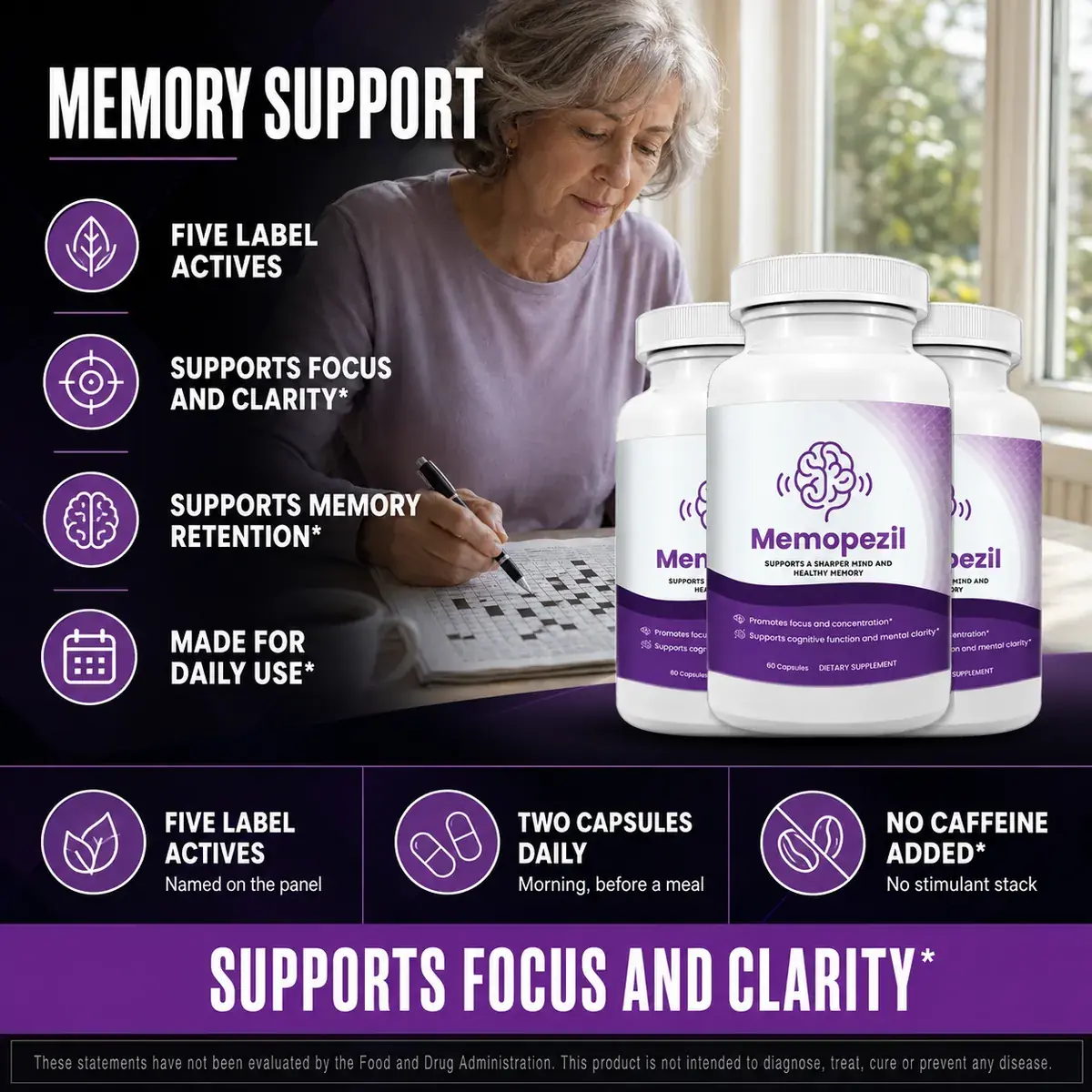
- Five actives, all with published milligram amounts — theanine, bacopa, rhodiola, ginseng, BCAAs.
- A short panel is a choice, not an omission. Five ingredients at real doses fit where fifteen would not.
- Ginkgo’s absence is the one buyers ask about most, and its evidence is more mixed than its reputation.
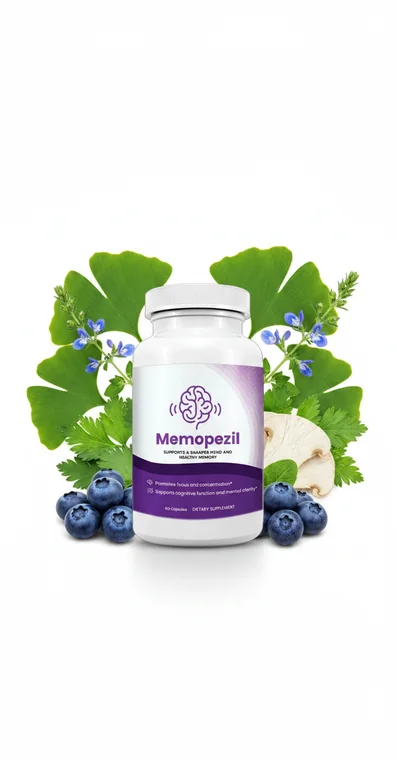
- Product photography is not a label. If a plant appears in a picture and not on the panel, it is not in the bottle.
This is general information, not medical advice. Memopezil is a dietary supplement. It is not a medicine, it is not donepezil, and it is not a treatment for Alzheimer’s disease, dementia or mild cognitive impairment. New or worsening memory problems are a reason to see a doctor. Never stop or change a prescription because of a supplement.
What is actually in it, for reference
Before the absences, the presences — because the whole argument below rests on the fact that every one of these carries a number.
| Active | Amount | Mainly studied for |
|---|---|---|
| BCAAs 2:1:1 | 540 mg | Exercise and muscle protein synthesis |
| Bacopa monnieri extract | 200 mg | Memory acquisition, over twelve weeks |
| L-theanine | 100 mg | Calm attention, stress measures |
| Rhodiola rosea extract | 100 mg | Physical and mental fatigue |
| Panax ginseng extract | 90 mg | Cognitive function, mixed literature |
Five rows, five numbers. That is unusual in this category and it is the reason a short panel is defensible: the alternative to five ingredients at published doses is fifteen ingredients sharing an undisclosed blend, which is what most of the shelf does.
Ginkgo biloba — the absence people ask about
Ginkgo is the most recognisable name in memory supplements and the one whose absence prompts the most email. Three things are worth knowing.
Its reputation outruns its evidence. Ginkgo has been studied more than almost anything else in this area, including in large trials designed to test whether it prevents cognitive decline, and the results have been broadly disappointing rather than encouraging. An ingredient being famous and an ingredient being effective are different facts.
It carries real interaction warnings. Ginkgo affects clotting and is one of the botanicals most often flagged alongside anticoagulants — a genuine consideration in the older population most interested in memory support.
It would have cost dose space. On a five-ingredient panel with published amounts, adding a sixth at a meaningful dose means reducing the others or making the serving bigger. That is the trade every formulator makes and most hide.
The photograph problem
The product image at the top of this page is framed with ginkgo leaves, and ginkgo is not in the product. That is ordinary category photography rather than anything deceptive, and it is still a good illustration of the rule: plants in a photograph are set dressing; the panel is the document. Ours is printed in full on the ingredients page.
Five actives, five published doses.
You can check every number on this label against the research yourself. That is rarer than it should be, and it is the reason to buy from the official website.
$294 — six bottles at $49 each
Order On The Official WebsiteFree US shipping · five digital bonuses · 60-day money-back guarantee
The other names you might be expecting
Lion’s mane
A mushroom with genuinely interesting laboratory work behind it and a thin human trial record — small studies, short durations, and not enough replication to support a confident claim. It is a reasonable thing to be curious about and a hard thing to justify at a real dose today.
Huperzine A
An alkaloid that acts on the same enzyme that prescription Alzheimer’s drugs target. That is precisely why it is not here: an ingredient with a drug-like mechanism on a supplement panel invites exactly the confusion this website spends a whole separate post correcting. It also carries interaction and side-effect considerations that a supplement is poorly placed to manage.
Omega-3 and phosphatidylserine
Both are associated with brain health, and both are bulky. Meaningful omega-3 doses are measured in grams and come as softgels; phosphatidylserine trials use hundreds of milligrams. Neither fits alongside five actives in two capsules a day, and including a token amount would be decoration rather than formulation.
Caffeine and other stimulants
Absent by design. Nothing here produces a same-day lift, which is a deliberate choice and the reason this product asks to be judged over weeks.
And the things that are in it but are not actives
“What is in it” has a second answer that labels rarely discuss: the capsule itself and whatever carries the powder. These are called excipients, and while they are not doing anything for your memory, they are the part of the label that decides whether a product suits you at all.
- The capsule shell. Gelatin or a plant-based alternative such as HPMC. This is the detail that matters if you are vegetarian or vegan, or avoiding pork or beef for religious reasons.
- Flow agents and anti-caking agents. Small amounts of things like magnesium stearate or silica, present so that powder moves through filling machinery evenly. They are inert at these amounts and they still belong on a label.
- Allergen statements. Whether the facility handles milk, soy, wheat, nuts or shellfish. For someone with a genuine allergy this is the most important line on the whole panel, and it is nothing to do with efficacy.
The full set for this product, as printed, is on the ingredients page, and the bottle you receive is the authority if the two ever disagree — formulations change, and a printed panel outranks any website including this one.
Why we are telling you about the boring part
Because it is the part that produces the most returns. Nobody sends a bottle back over a milligram of rhodiola; people send bottles back because the capsule turned out to be gelatin, or because a facility statement ruled it out for them. Both are avoidable by reading a panel before ordering, which is why ours is published in full rather than shown at checkout.
Why a short panel is usually the better sign
Buyers reasonably read a long ingredient list as better value. The arithmetic says otherwise, and it is simple enough to do in your head.
- A capsule holds a finite amount. Every ingredient added takes space from the others; there is no way around it.
- Long lists usually mean a blend. Fifteen names almost always share one undisclosed total, because publishing fifteen honest amounts would show how small most of them are.
- Published doses are checkable. Five numbers can be compared against five bodies of research. An undisclosed blend cannot be compared against anything.
- Absences are informative. A formulator who left ginkgo off a memory panel made a decision, and a decision can be explained — which is what this page is.
NCCIH's guidance on dietary and herbal supplements is the neutral reference for weighing any individual botanical, and their Asian ginseng page covers the one botanical here that does have a famous name.
How to compare this panel against another
If you are choosing between Memopezil and something else, the comparison that actually works takes about two minutes and ignores the front of both boxes.
- Find the serving size on each. One capsule against three changes every number underneath, and comparing per-serving figures across different serving sizes is the commonest mistake there is.
- Count the published amounts. Not the ingredients — the ones with a number beside them. On this label it is five of five. On a blend it is often zero.
- Pick one shared ingredient and compare it directly. If both contain bacopa, compare the milligrams. If one hides it in a blend, you have your answer about which label is more useful.
- Check the standardisation. “Standardised to X%” tells you about strength; a bare plant name does not. This matters more than the raw milligram figure for any extract.
- Compare cost per day, not per bottle. A cheaper bottle at three capsules a day is not cheaper.
- Then read the absences. What a formula leaves out, and whether anyone will explain why, tells you how the people behind it think.
Run those six on us and on whatever else you are considering. If another product wins, it wins — we would rather you bought the better label than bought ours on a photograph.
What we would add, if the evidence changed
A fair question to end on, and the honest answer is that we do not formulate the product — this website is the authorised United States distributor, not the manufacturer. What we can say is which absences would be worth revisiting and which would not.
- Lion’s mane, if larger human trials replicate the early work. The most plausible candidate on this page.
- Omega-3, if the format changed to accommodate a real dose. Unlikely in two capsules.
- Ginkgo, only if the trial picture improved substantially. On current evidence it would add a famous name and an interaction warning.
- Huperzine A, no. The drug-adjacent mechanism is a reason to stay away, not a selling point.
NCCIH's research digest on supplements and cognitive function tracks how this evidence base moves, and the National Institute on Aging and their summary on diet and prevention are the references worth reading before any of it. The ODS consumer guide is the plainest statement of what a supplement is for in the first place — an addition, not a replacement.
References
- National Center for Complementary and Integrative Health. Asian ginseng. https://www.nccih.nih.gov/health/asian-ginseng
- National Center for Complementary and Integrative Health. Dietary supplements and cognitive function, dementia, and Alzheimer's disease: what the science says. https://www.nccih.nih.gov/health/providers/digest/dietary-supplements-and-cognitive-function-dementia-and-alzheimers-disease-science
- National Institute on Aging. Cognitive health and older adults. https://www.nia.nih.gov/health/brain-health/cognitive-health-and-older-adults
- National Institute on Aging. What do we know about diet and prevention of Alzheimer's disease? https://www.nia.nih.gov/health/alzheimers-and-dementia/what-do-we-know-about-diet-and-prevention-alzheimers-disease
- National Center for Complementary and Integrative Health. Dietary and herbal supplements. https://www.nccih.nih.gov/health/dietary-and-herbal-supplements
- National Institutes of Health, Office of Dietary Supplements. Dietary supplements: what you need to know. https://ods.od.nih.gov/factsheets/WYNTK-Consumer/
Every page, every journal post, the bottle facts and the ingredients go through review by Dr. Janyna Mercado before they ship. Memopezil is unusual in this category: it publishes a milligram figure for every active. That lets us do something most supplement pages cannot — put each published dose directly beside the dose used in the human trials, and tell you which ones match and which fall short. We do that on every ingredient, including the three that do not measure up. Corrections are made on the page itself and the review date moves forward — write to [email protected]. Last reviewed September 2026 by Dr. Janyna Mercado.
Five names, five numbers.
A short panel you can check beats a long one you cannot. Sixty days is long enough to find out what it does for you.
$294 — six bottles at $49 each
Order Memopezil On The Official WebsiteFree US shipping · five digital bonuses · 60-day money-back guarantee · lot MPZ-2026-NY-0847