Memopezil Official Website › Ingredients
Memopezil Ingredients: Every Dose on the Label
Five actives, five published milligram figures. Below is every one of them, what the human research found, the dose that research used, and a plain verdict on whether this label reaches it.
Memopezil has five active ingredients and no caffeine.
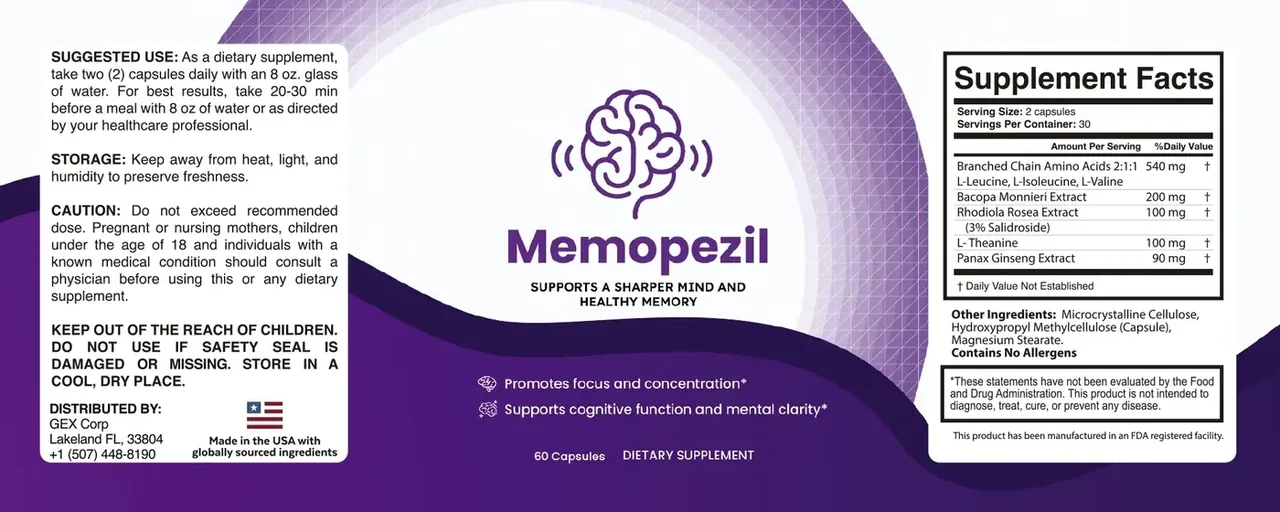
A two-capsule serving gives BCAAs 2:1:1 at 540 mg, bacopa monnieri at 200 mg, rhodiola rosea at 100 mg (3% salidroside), L-theanine at 100 mg and Panax ginseng at 90 mg. Every dose is printed, with no proprietary blend.
Memopezil supplement facts
| Per 2-capsule serving | Amount |
|---|---|
| BCAAs 2:1:1 | 540 mg |
| Bacopa Monnieri Extract | 200 mg |
| Rhodiola Rosea Extract (3% salidroside) | 100 mg |
| L-Theanine | 100 mg |
| Panax Ginseng Extract | 90 mg |
| Microcrystalline cellulose | — |
| HPMC capsule shell | — |
| Magnesium stearate | — |
Contains no caffeine and no stimulants. Confirm against the panel printed on your own bottle — that panel is the authority, not this page. Directions: two capsules daily in the morning with water, 20–30 minutes before a meal.
Why a dosed Memopezil label is worth more than a long one
Under 21 CFR 101.36, a manufacturer may bundle ingredients into a proprietary blend and publish only the total weight, listing the contents in descending order without quantifying any of them. the FDA labeling guide sets out the same rule. Most supplements in this category do exactly that, and the result is a label you cannot check.
Memopezil does not. Every active carries a number. That single decision is what makes the page you are reading possible: for each ingredient we can look up the dose used in the human trials and put it directly beside the dose in the capsule.
Do not mistake that for a claim that the doses are generous. Three of the five are well below the studied range and we say so in each entry. But a label you can audit and find wanting is more useful than a label that hides the same shortfall behind a single milligram total — and it is a fair reason to trust this manufacturer slightly more than the ones that do not disclose.
Every Memopezil active, its evidence, and whether the dose reaches it
L-Theanine
100 mgCamellia sinensis amino acid · Amino acid
The one that matches its research, and the reason to take this product seriously. L-theanine is the amino acid in tea leaf associated with calm alertness — relaxation without sedation. Evidence: a 2022 dose-response crossover study tested 100, 200 and 400 mg against placebo and found that 100 mg significantly improved reaction time on simple visuomotor tasks, by roughly 16 ms. A separate 2019 randomised controlled trial in healthy adults reported reductions in stress-related symptoms and improvements on some cognitive measures. The verdict: Memopezil supplies exactly 100 mg, which is a dose the literature has actually tested and found effects at. That is unusual on a label like this, and it deserves saying plainly. The caveat: the same dose-response study found the larger effects on more complex attention measures at 400 mg, not 100. So this is a real dose, at the low end of the useful range.
Sources: 2023 dose-response crossover study · 2019 randomized controlled trial
Bacopa Monnieri Extract
200 mgBrahmi · Botanical
The most-studied memory botanical on this panel, and the one buyers are really paying for. Evidence: a 2014 meta-analysis of nine randomised controlled trials in 437 participants found improved speed of attention and reduced reaction time. A randomised controlled trial in age-associated memory impairment reported improvements in logical memory and paired-associate learning. The dose gap: the trials in that literature used 300 to 450 mg a day of standardised extract. Memopezil supplies 200 mg — roughly two thirds of the lower bound. Not a token amount by any means, and closer than most products get, but below the range the evidence was generated in. And the null result should be on the page too: a 2010 trial by Morgan and Stevens gave 300 mg daily for twelve weeks to 101 adults aged 40–70 with self-reported memory complaints and found no greater improvement than placebo. The literature is genuinely mixed. Caution: the StatPearls monograph notes that gastrointestinal upset — nausea, cramping, loose stools — is the common adverse effect, which is why the label says to take it before a meal.
Sources: 2014 meta-analysis · Randomized controlled trial in age-associated memory impairment · Morgan & Stevens 2010 trial · StatPearls monograph
Rhodiola Rosea Extract
100 mgGolden root · 3% salidroside · Botanical
An adaptogen used for fatigue rather than memory, and standardised here to 3% salidroside — a real specification, not just a plant name. Evidence: a 2012 systematic review of eleven trials found that three of five randomised trials on mental fatigue reported benefit, while noting that methodological flaws limit how much weight the literature can carry. A later dose-response trial found effects across a 200–1,500 mg a day range. The dose gap: Memopezil supplies 100 mg, below the bottom of that range. What it is realistically doing: if anything, taking the edge off mental fatigue rather than improving memory. One reviewer describes the calm as the first thing she noticed, and that is a fair description of what theanine and rhodiola together would be expected to do. Caution: NCCIH notes possible interactions with antidepressants and limited safety data in pregnancy.
Sources: 2012 systematic review · NCCIH
Panax Ginseng Extract
90 mgAsian ginseng · Botanical
The classic cognitive botanical, and the smallest dose on this panel. Evidence: a 2024 systematic review and meta-analysis pooling fifteen randomised trials found effects on cognitive measures across mixed populations, and a 2019 systematic review notes that the most consistent finding in healthy adults is on secondary memory, typically at single doses around 400 mg. The dose gap: 90 mg is roughly a fifth of that. This is the weakest dose-to-evidence match on the label and we are not going to dress it up. Caution — and this one matters: NCCIH lists interactions with blood thinners such as warfarin, with diabetes medication (ginseng can lower blood glucose), and with some antidepressants. If you take any of those, this is a conversation for your pharmacist before your first capsule, regardless of the dose being modest.
Sources: 2024 systematic review and meta-analysis · 2019 systematic review · NCCIH
BCAAs 2:1:1
540 mgLeucine, isoleucine, valine · Amino acids
The largest number on the panel, and the one with the least to do with memory. Branched-chain amino acids in the standard 2:1:1 ratio are a sports-nutrition staple, used for muscle protein synthesis and exercise recovery. Evidence: The NIH Office of Dietary Supplements summarises what BCAAs have been studied for — exercise performance and recovery — and notes the evidence there is mixed. Leucine and valine do compete with tryptophan for transport across the blood-brain barrier, which is the theoretical route by which BCAAs are argued to affect central fatigue, and that is presumably the reasoning here. The dose gap: BCAA research uses grams — typically 5 to 20 g a day. 540 mg is under a tenth of the low end. Being blunt: this is the biggest milligram figure on the label and the ingredient least connected to what the product is sold for. It makes the panel look substantial. It is not doing what the other four are there to do.
Sources: NIH Office of Dietary Supplements
All five Memopezil actives, side by side
| Active | On the label | In the research | Verdict |
|---|---|---|---|
| L-Theanine | 100 mg | 100–400 mg | Matches. Effects found at exactly 100 mg. |
| Bacopa monnieri | 200 mg | 300–450 mg | Below the range, but the closest miss. |
| Rhodiola rosea | 100 mg | 200–1,500 mg | Under the bottom of the range. |
| Panax ginseng | 90 mg | ~400 mg typical | About a fifth. The weakest botanical match. |
| BCAAs 2:1:1 | 540 mg | 5–20 g | Under a tenth — and not a memory ingredient. |
Every page, every journal post, the bottle facts and the ingredients go through review by Dr. Janyna Mercado before they ship. Memopezil is unusual in this category: it publishes a milligram figure for every active. That lets us do something most supplement pages cannot — put each published dose directly beside the dose used in the human trials, and tell you which ones match and which fall short. We do that on every ingredient, including the three that do not measure up. Corrections are made on the page itself and the review date moves forward — write to [email protected]. Last reviewed September 2026 by Dr. Janyna Mercado.
Memopezil references
- Kongkeaw C, Dilokthornsakul P, Thanarangsarit P, Limpeanchob N, Norman Scholfield C. Meta-analysis of randomized controlled trials on cognitive effects of Bacopa monnieri extract. Journal of Ethnopharmacology. 2014. https://pubmed.ncbi.nlm.nih.gov/24252493/
- Morgan A, Stevens J. Does Bacopa monnieri improve memory performance in older persons? Results of a randomized, placebo-controlled, double-blind trial. Journal of Alternative and Complementary Medicine. 2010. https://pubmed.ncbi.nlm.nih.gov/20590480/
- Raghav S, Singh H, Dalal PK, Srivastava JS, Asthana OP. Randomized controlled trial of standardized Bacopa monniera extract in age-associated memory impairment. Indian Journal of Psychiatry. 2006. https://www.ncbi.nlm.nih.gov/pmc/articles/PMC2915594/
- Bacopa monnieri. StatPearls, NCBI Bookshelf. https://www.ncbi.nlm.nih.gov/books/NBK589635/
- Ishaque S, Shamseer L, Bukutu C, Vohra S. Rhodiola rosea for physical and mental fatigue: a systematic review. BMC Complementary and Alternative Medicine. 2012. https://www.ncbi.nlm.nih.gov/pmc/articles/PMC3541197/
- National Center for Complementary and Integrative Health. Rhodiola. https://www.nccih.nih.gov/health/rhodiola
- Dassanayake TL, Wijesundara D, Kahathuduwa CN, Weerasinghe VS. Dose-response effect of L-theanine on psychomotor speed, sustained attention, and inhibitory control: a double-blind, placebo-controlled, crossover study. Nutritional Neuroscience. 2023;26(11):1138-1146. https://pubmed.ncbi.nlm.nih.gov/36263942/
- Hidese S, Ogawa S, Ota M, et al. Effects of L-theanine administration on stress-related symptoms and cognitive functions in healthy adults: a randomized controlled trial. Nutrients. 2019. https://www.ncbi.nlm.nih.gov/pmc/articles/PMC6836118/
- Effects of ginseng on cognitive function: a systematic review and meta-analysis. 2024. https://pubmed.ncbi.nlm.nih.gov/39474788/
- A systematic review of research investigating the physiological and psychological effects of combining Ginkgo biloba and Panax ginseng into a single treatment in humans. 2019. https://www.ncbi.nlm.nih.gov/pmc/articles/PMC6422825/
- National Center for Complementary and Integrative Health. Asian ginseng. https://www.nccih.nih.gov/health/asian-ginseng
- National Institutes of Health, Office of Dietary Supplements. Dietary supplements for exercise and athletic performance. https://ods.od.nih.gov/factsheets/ExerciseAndAthleticPerformance-HealthProfessional/
- National Center for Complementary and Integrative Health. Dietary supplements and cognitive function, dementia, and Alzheimer's disease: what the science says. https://www.nccih.nih.gov/health/providers/digest/dietary-supplements-and-cognitive-function-dementia-and-alzheimers-disease-science
- National Institute on Aging. Cognitive health and older adults. https://www.nia.nih.gov/health/brain-health/cognitive-health-and-older-adults
- National Institute on Aging. What do we know about diet and prevention of Alzheimer's disease? https://www.nia.nih.gov/health/alzheimers-and-dementia/what-do-we-know-about-diet-and-prevention-alzheimers-disease
- U.S. Government Publishing Office, eCFR. 21 CFR 101.36 — Nutrition labeling of dietary supplements. https://www.ecfr.gov/current/title-21/chapter-I/subchapter-B/part-101/subpart-C/section-101.36
- U.S. Food and Drug Administration. Dietary supplement labeling guide: Chapter IV, nutrition labeling. https://www.fda.gov/food/dietary-supplements-guidance-documents-regulatory-information/dietary-supplement-labeling-guide-chapter-iv-nutrition-labeling
- U.S. Food and Drug Administration. Questions and answers on dietary supplements. https://www.fda.gov/food/information-consumers-using-dietary-supplements/questions-and-answers-dietary-supplements
- National Center for Complementary and Integrative Health. Dietary and herbal supplements. https://www.nccih.nih.gov/health/dietary-and-herbal-supplements
- National Institutes of Health, Office of Dietary Supplements. Dietary supplements: what you need to know. https://ods.od.nih.gov/factsheets/WYNTK-Consumer/
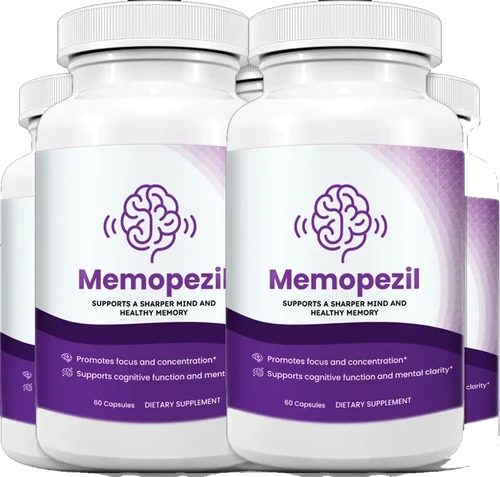
Memopezil: one clear match, one near miss, three shortfalls.
That is the honest scorecard, and it is more than most labels in this category will let you calculate. Sixty days is long enough to decide what it is worth to you.
$294 — six bottles at $49 each
Order Memopezil On The Official WebsiteFree US shipping · five digital bonuses · 60-day money-back guarantee · lot MPZ-2026-NY-0847